How Much Does It Cost to Hire a Dedicated Flutter Developer in 2026?
Table of Contents
Subscribe To Our Newsletter

Summarize with AI
Not enough time? get the key points instantly.
Hiring a dedicated Flutter developer in 2026 typically costs $15–$30 per hour for junior talent, $30–$60 for mid-level developers and $60–$100+ for senior specialists. For a 160-hour working month, that equals approximately $2,400–$4,800, $4,800–$9,600 and $9,600–$16,000+, respectively, before adding UI/UX design, backend engineering, QA, cloud infrastructure or paid integrations.
This distinction matters for CTOs, product leaders and founders comparing individual developer rates with the complete cost of delivering and maintaining a cross-platform application. Google’s official Flutter documentation, updated in July 2026, lists support for Android, iOS, Windows, macOS, Linux and web.
That six-platform reach can reduce duplicated front-end work, although native integrations, device testing and platform-specific release requirements still affect the estimate. At Codiant, businesses can onboard pre-vetted Flutter developers within 12–24 hours and use a seven-day free trial to assess technical skills, communication and delivery fit.
This cost analysis compares hourly and monthly pricing, regional rates, experience levels, engagement models, scope inclusions and hidden expenses, with Codiant’s dedicated hiring process as the practical evaluation framework.
Key Takeaways
- A dedicated Flutter developer typically costs $15–$100+ per hour, based on experience.
- Match developer seniority to architecture, integrations, security and code-ownership responsibilities.
- At 160 monthly hours, developer-only costs range from $2,400 to $16,000+.
- The biggest mistake is comparing hourly rates without checking inclusions, exclusions and supporting roles.
- Codiant onboards pre-vetted Flutter developers within 12–24 hours with a seven-day free trial before long-term commitment.
How Much Does It Cost to Hire a Dedicated Flutter Developer?
Hiring a dedicated Flutter developer generally costs $2,400 to $16,000+ per month, based on published hourly benchmarks and an illustrative 160-hour monthly allocation. Businesses may pay less for part-time support or more for senior architecture, regulated-industry knowledge, complex native integrations and extended working-hour overlap.
| Developer level | Estimated hourly rate | Illustrative monthly cost | Suitable responsibilities |
| Junior Flutter developer | $15–$30 | $2,400–$4,800 | UI changes, simple screens and bug fixes |
| Mid-level Flutter developer | $30–$60 | $4,800–$9,600 | MVPs, APIs, state management and features |
| Senior Flutter developer | $60–$100+ | $9,600–$16,000+ | Architecture, security and complex integrations |
The monthly amounts were calculated using:
Hourly rate × 160 hours = illustrative monthly cost
For example, the developer-only cost of hiring a mid-level developer at $40 per hour would be:
$40 × 160 hours = $6,400 per month
This does not mean every mid-level developer will cost $6,400 monthly. The actual allocation may be lower or higher, and the proposal may include management, technical supervision or other services.
Codiant’s published Flutter hiring guide also estimates that a dedicated Flutter team may cost $4,000–$20,000+ per month, depending on whether the team includes Flutter development, backend engineering, UI/UX design, QA, DevOps and project management.
Know Your Flutter Hiring Cost Before Making a Commitment Today
Share your project scope to receive matched profiles and transparent pricing options.
What Affects Flutter Developer Pricing?
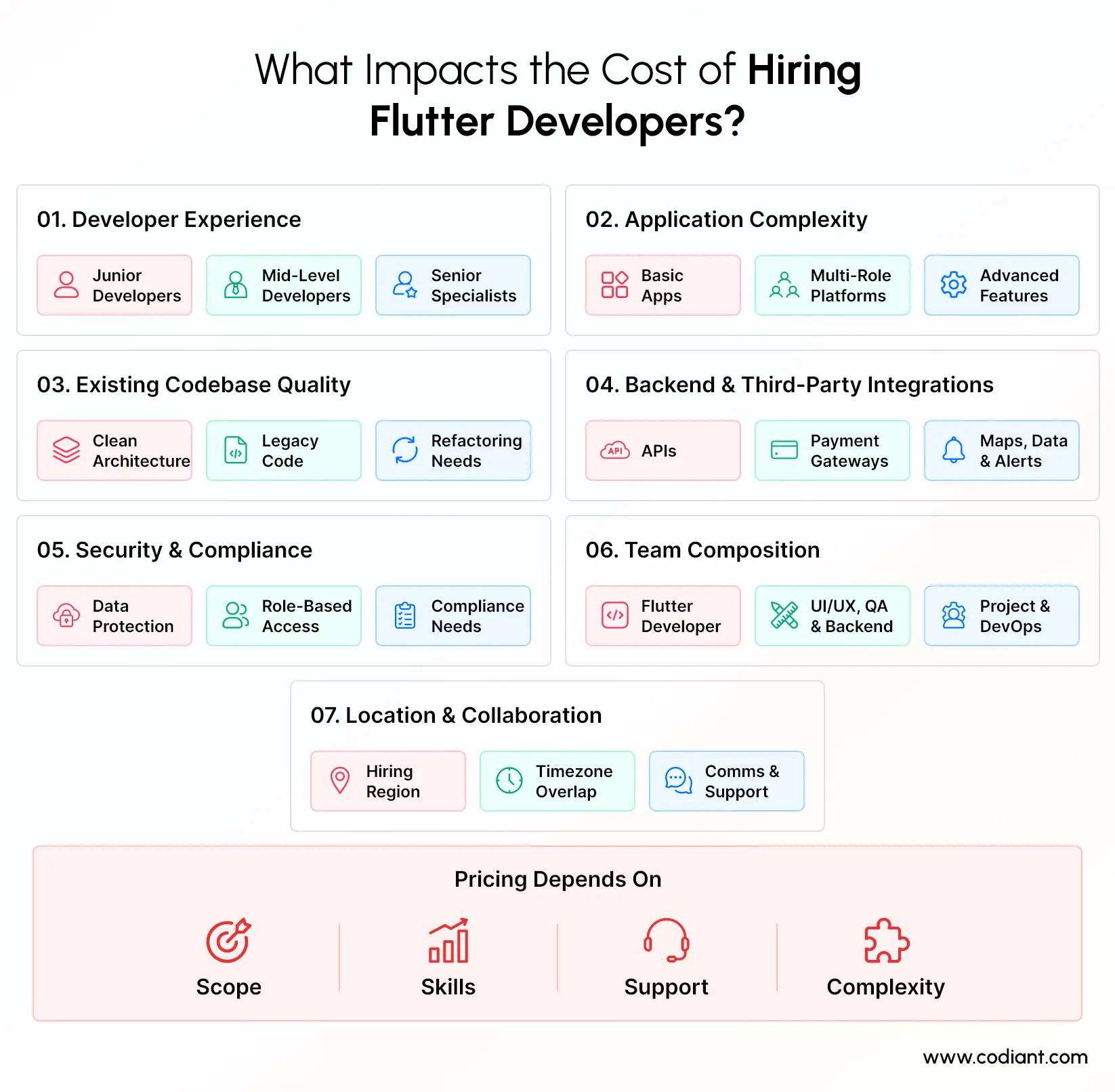
Flutter developer pricing is mainly affected by experience, application complexity, codebase quality, integrations, security requirements, team composition and hiring location. A developer building standard application screens will not require the same budget as one responsible for enterprise architecture, offline synchronization and complex native integrations.
1. Developer experience
Junior developers are generally suitable for defined tasks completed under supervision. Mid-level developers can own features, API integrations and state management, while senior developers handle architecture, scalability, complex debugging and technical leadership.
2. Application complexity
A basic content application costs less to develop than a fintech platform, marketplace, healthcare application or logistics solution. Live tracking, real-time communication, offline access, multiple user roles, subscriptions and advanced analytics increase development and testing effort.
3. Existing codebase quality
Working on an organized, documented application is more predictable than modifying a poorly structured legacy product. Weak test coverage, outdated dependencies and undocumented APIs may require an audit or refactoring phase before new development begins.
4. Backend and third-party integrations
Flutter covers the application interface, but commercial products usually depend on backend services. Payment gateways, maps, CRM platforms, analytics, authentication, notifications and device hardware can add implementation and testing costs.
5. Security and compliance
Applications handling financial, medical or confidential enterprise data may need encryption, role-based permissions, audit logs, secure storage, compliance documentation and security testing.
6. Team composition
One dedicated Flutter developer may not be sufficient for full product delivery. The scope may also require a business analyst, designer, backend developer, QA engineer, DevOps specialist or project manager.
7. Location and collaboration
Flutter developer rates 2026 vary by region, but the hourly figure should not be considered in isolation. Communication quality, time zone overlap, replacement terms, technical supervision and vendor overhead also affect total value. If you hire mobile app developers in USA, it will cost more as compared to European and Asian app developers.
Dart Remains a Specialist Development Skill
6.1% of professional developers in Stack Overflow’s 2025 Developer Survey reported doing extensive development work with Dart during the previous year. The result was based on 24,759 professional developer responses.
Because Flutter applications are primarily written in Dart, this provides a directional view of the available language talent pool. It does not prove that Flutter developers are scarce or automatically command higher rates. Businesses should verify production Flutter experience, architecture knowledge and platform-integration skills rather than treating general mobile development experience as equivalent.
Source: Survey.stackoverflow.co
What Should Flutter App Developer Pricing Include?
Flutter app developer pricing should clearly separate developer effort, additional roles, infrastructure expenses and excluded work. Otherwise, a low hourly rate may be mistaken for the complete cost of delivering an application.
A Flutter developer estimate may include:
- Requirement analysis and technical planning
- Flutter and Dart application engineering
- UI implementation
- State management and architecture
- API and third-party integrations
- Native Android or iOS bridging
- Unit, widget and integration testing
- Code reviews and documentation
- Android and iOS build preparation
- Sprint planning and progress reporting
- Agreed bug-fixing support
The following items may be priced separately:
- Product discovery
- UI/UX design
- Backend development
- Admin-panel development
- Cloud hosting
- Paid APIs and software licences
- Data migration
- Penetration testing
- Compliance certification
- App-store developer accounts
- Long-term maintenance
- Features added after scope approval
The estimate should also identify the supported platforms, user roles, screens, languages, integrations, devices and approval timelines. These assumptions directly affect effort and cost.
Which Hiring Model Offers the Best Value?
A dedicated developer usually offers the best value for an evolving product with a continuous backlog. Fixed-cost delivery is generally more suitable when requirements, deliverables and acceptance criteria are unlikely to change.
Codiant currently offers dedicated developer, time-and-material, and fixed-cost engagement models for Flutter development services. The dedicated model supports recurring full-time or part-time resource allocation, while the time-and-material model uses hourly billing for evolving requirements. The fixed-cost model is based on predetermined deliverables and milestone-based payments.
| Hiring model | Best suited for | Pricing structure | Main consideration |
| Hourly | Audits, fixes and short assignments | Hours used | Total cost can vary |
| Time and material | Changing requirements and experiments | Recorded time and resources | Requires ongoing budget control |
| Dedicated developer | Continuous product development | Monthly or agreed allocation | Needs an active backlog |
| Dedicated team | Full-cycle product delivery | Recurring team cost | Includes multiple specialists |
| Fixed cost | Stable and documented requirements | Milestone-based price | Scope changes may cost extra |
| In-house employee | Permanent internal capability | Salary and employment overhead | Longer hiring process |
The lowest hourly rate does not always create the lowest final cost. Delays, rework, weak documentation and poor architecture can increase total spending even when the initial rate appears attractive.
Should You Hire Freelance or Dedicated Flutter Developers from Codiant?
Hire a freelance Flutter developer for a small, isolated and clearly testable assignment. Hire a dedicated Flutter developer from Codiant when the work is ongoing, business-critical or dependent on consistent availability, structured communication and access to additional specialists.
Upwork reports that historical app-developer contracts commonly fall between $18 and $39 per hour, while noting that actual rates remain subject to negotiation. This is a broad marketplace reference and does not guarantee the cost, availability or expertise of a particular Flutter developer.
| Evaluation area | Freelance developer | Dedicated Codiant developer |
| Suitable for | Small tasks and prototypes | Ongoing product development |
| Availability | May be shared across clients | Agreed allocation |
| Screening | Managed by the buyer | Pre-vetted profiles provided |
| Additional specialists | Hired separately | Can be added through the team |
| Replacement support | Depends on the individual | Managed through the vendor |
| Trial arrangement | Negotiated separately | Seven-day trial advertised |
| Onboarding | Depends on availability | 12–24 hours advertised |
Codiant’s current Flutter page states that businesses can interview shortlisted developers, onboard selected talent within 12–24 hours and use a seven-day trial to evaluate technical ability, communication and performance. These advertised terms should be reconfirmed in the final commercial agreement.
A freelancer can still be the right choice for a bounded assignment. A dedicated model becomes more valuable when continuity, collaboration and long-term code ownership matter.
Start Flutter Projects with the Right Developer from Day One
Use a seven-day trial to assess skills, communication, ownership, and project fit.
Where Can You Hire Flutter Developers?
Businesses can hire Flutter developers through development companies, freelance marketplaces, curated talent platforms, staffing firms or direct employment. The right source depends on whether the priority is short-term affordability, specialist expertise, rapid onboarding or end-to-end delivery support.
A freelance marketplace may suit a small task when the buyer can independently assess technical quality. Curated networks can provide access to individual specialists, while development companies are more suitable when the scope also requires product discovery, UI/UX, backend engineering, QA or ongoing support. US-focused buyers can compare Flutter app development companies in the USA based on verified applications, technical capabilities, engagement flexibility, industry experience and post-launch commitments.
Codiant provides remote Flutter developers through dedicated, part-time, hourly and fixed-cost engagement models. Its current Flutter service page advertises pre-vetted profiles, candidate interviews, 12–24-hour onboarding and a seven-day developer trial.
Before selecting Flutter developers for hire, verify:
- Live applications they have worked on
- Their exact contribution to each project
- Dart and Flutter proficiency
- Architecture and state-management knowledge
- API and native integration experience
- Testing and debugging practices
- App Store and Google Play experience
- Communication and availability
- Code-review practices
- Security awareness
Portfolio images alone do not prove that a candidate developed the production application or designed its architecture.
How Do Flutter Developer Rates Vary by Location in 2026?
Published Flutter developer rate estimates range from approximately $18–$39 per hour in India to $80–$150+ in the United States. Eastern Europe, Southeast Asia and Western Europe generally fall between these ranges.
| Hiring location | Estimated hourly rate |
| United States | $80–$150+ |
| UK and Western Europe | $70–$130 |
| Eastern Europe | $40–$80 |
| India | $18–$39 |
| Southeast Asia | $25–$50 |
These figures are directional estimates rather than standardized market prices. Experience, domain knowledge, project duration and the services included in the contract can substantially change the final rate.
Mobile Developer Compensation Varies Sharply by Location
The 2025 Stack Overflow Developer Survey reported a global median annual compensation of $69,609 for mobile developers, based on self-reported salary data. The corresponding median was $170,000 in the United States, $99,383 in the United Kingdom and $10,462 in India.
Source: Survey.stackoverflow.co
When comparing Flutter outsourcing cost, evaluate more than geography. Consider:
- Relevant application experience
- Code and documentation quality
- Time zone overlap
- Communication ability
- Data-security controls
- Notice and replacement terms
- Access to senior technical review
- Ability to scale the team
A lower-cost developer who requires extensive supervision may create more internal work than a stronger developer charging a higher rate.
How Much Does Flutter App Development Cost by Project Type?
A complete Flutter application may cost from $10,000 for a basic build to $250,000+ for an enterprise product. Project pricing is higher than an individual developer’s rate because full delivery may require planning, design, backend engineering, testing, deployment and project management.
| Flutter application type | Estimated development cost | Typical timeline |
| Basic Flutter app | $10,000–$25,000 | 8–12 weeks |
| MVP Flutter app | $25,000–$50,000 | 3–4 months |
| Mid-level business app | $50,000–$100,000 | 4–6 months |
| Enterprise Flutter app | $100,000–$250,000+ | 6+ months |
| On-demand or marketplace app | $70,000–$180,000+ | 5–8 months |
These ranges should be treated as early planning estimates, not universal quotations.
For example, one marketplace may only require listings, profiles and basic payments. Another may need separate customer and provider applications, live tracking, messaging, identity verification, dynamic pricing, dispute handling and a complex administration system. Both are marketplaces, but their development costs will differ substantially.
Why Can Flutter Reduce Cross-Platform Development Cost?
Flutter can reduce duplicated front-end development because one codebase can target multiple platforms. Flutter’s official website states that teams can deploy to mobile, web and desktop, while its documentation confirms support across Android, iOS, Windows, macOS, Linux and web environments.
Flutter also provides Hot Reload, which lets developers view code changes quickly during development without restarting the entire application state. This can support faster UI iteration and debugging.
However, Flutter does not make every project completely platform-independent. Teams may still need:
- Platform-specific permissions
- Native SDK integrations
- Android and iOS device testing
- Store-compliance adjustments
- Responsive layouts
- Platform-specific user experiences
- Separate desktop or web optimization
The cost benefit is generally strongest when Android and iOS applications share similar features, branding, workflows and release schedules. Native development may remain more suitable when the product depends heavily on specialized platform capabilities or hardware.
How Can Businesses Estimate Flutter Developer Cost Accurately?
Calculate Flutter developer cost using rate, monthly allocation, engagement duration and supporting roles. Then add infrastructure, paid services, testing and maintenance instead of treating the developer’s rate as the complete project budget.
Use this basic formula:
Estimated developer cost = hourly rate × monthly hours × engagement duration
For example:
$40 per hour × 160 hours × 3 months = $19,200
This $19,200 figure only covers the assumed developer allocation. It does not automatically include UI/UX design, backend APIs, QA, DevOps, cloud usage or paid integrations.
Before accepting an estimate, confirm:
- Defined deliverables
- Acceptance criteria
- Developer experience level
- Monthly hours
- Supporting team members
- Included platforms
- Integration responsibilities
- Security activities
- Testing coverage
- Deployment support
- Reporting frequency
- Assumptions and exclusions
- Change-request process
- Warranty and maintenance
This framework makes it easier to compare quotations because it reveals whether price differences come from rates or from different scopes.
How Can Businesses Reduce Flutter Outsourcing Cost?
Businesses can reduce Flutter outsourcing cost by controlling scope, matching seniority to responsibility and preventing avoidable rework. Selecting the cheapest Flutter developer hourly rate is not the same as controlling total delivery cost.
Start with the smallest commercially useful release. Separate required features from later improvements, define API contracts and approve critical application flows before intensive development begins.
Use senior developers where their expertise matters most. A senior developer can define the architecture and review complex work, while mid-level developers handle feature implementation. Using only senior developers may be unnecessarily expensive, but asking junior developers to make architectural decisions can create costly technical debt.
Additional cost controls include:
- Conducting an initial code audit
- Using documented acceptance criteria
- Maintaining a prioritized backlog
- Releasing in short iterations
- Reviewing code regularly
- Testing throughout development
- Tracking scope changes separately
- Starting with a limited trial or sprint
Codiant currently advertises a seven-day Flutter developer trial, allowing businesses to evaluate technical ability and communication before making a longer commitment.
When Is a Dedicated Flutter Developer the Best Choice?
A dedicated Flutter developer is usually the best choice when a business has an active roadmap, changing priorities and enough work to justify recurring capacity. The developer gains deeper knowledge of the product, architecture and business rules instead of repeatedly onboarding for isolated assignments.
Dedicated hiring is suitable when:
- New features are released regularly
- The application needs continuous maintenance
- Requirements will evolve through user feedback
- An internal team needs additional Flutter capacity
- Flutter work must coordinate with backend and design teams
- Long-term code ownership matters
- The team may need to scale later
Hourly support may be more appropriate for a short audit or isolated bug fix, while fixed-cost delivery suits a documented project with stable acceptance criteria. When the roadmap also requires backend, QA, DevOps, cloud or design expertise, a broader dedicated developer hiring model can make it easier to add complementary skills under one engagement structure.
What Is the Hourly Rate for Flutter Developers from Codiant?
Codiant offers flexible Flutter developer pricing based on the developer’s experience, project complexity, engagement duration and required working model. Businesses can choose hourly, part-time, full-time or fixed-cost engagement depending on whether they need short-term support, continuous development capacity or complete project delivery.
For initial budget planning, the following rate ranges can be considered:
- Junior Flutter developer: $15–$30 per hour
- Mid-level Flutter developer: $30–$60 per hour
- Senior Flutter developer: $60–$100+ per hour
- Dedicated Flutter team: $4,000–$20,000+ per month
These ranges provide a starting point for estimating Flutter developer costs. The final rate is aligned with the exact responsibilities, technical skills and level of support required for the project.
Pricing is usually evaluated against:
- Developer experience and domain expertise
- Part-time or full-time allocation
- Length of the engagement
- New development or existing application support
- Backend and API responsibilities
- Native Android or iOS integrations
- Testing and deployment requirements
- Security or compliance obligations
- Required time zone overlap
- Additional design, QA or DevOps support
A detailed proposal should clearly define the included services, estimated allocation, assumptions and any separately billed requirements. This gives businesses a transparent cost structure matched to their Flutter development roadmap.
What Should Businesses Check Before Accepting a Flutter Quote?
A Flutter developer quote should explain what the buyer receives for the stated rate. Avoid accepting an estimate that lists only a total price without defining hours, responsibilities, deliverables and exclusions.
The proposal should identify:
- Developer seniority and experience
- Full-time or part-time availability
- Expected monthly hours
- Included QA and management support
- Source-code and intellectual-property ownership
- NDA and security arrangements
- Working-hour overlap
- Replacement and notice terms
- Billing for meetings and reviews
- Scope-change procedures
- Deployment responsibilities
- Post-launch support
- Taxes and third-party expenses
A quotation confirms the commercial terms, but it does not establish whether the developer has the right technical and product experience. Following a structured process for hiring dedicated Flutter developers helps teams assess live applications, Dart proficiency, architecture knowledge, testing practices, communication and post-launch responsibilities before making a commitment.
A transparent estimate can still change when requirements change. The difference is that the buyer can see why the price changed and which original assumption no longer applies.
Build Your Flutter Team Without Lengthy Recruitment or Cost Uncertainty
Share your scope to receive matched developer profiles, engagement options and a transparent cost estimate.
The Author

Frequently Asked Questions
Flutter developer costs are influenced by experience, location, allocation, project complexity, integrations, security requirements and team composition. Existing code quality, testing expectations and native Android or iOS responsibilities can also change the required effort.
A dedicated developer generally offers the best value for ongoing product roadmaps and recurring releases. Fixed cost is better suited to stable, documented projects, while hourly engagement works well for audits, fixes and short assignments.
Codiant’s published estimate places enterprise Flutter development at approximately $100,000–$250,000+. Enterprise applications commonly involve advanced security, complex workflows, role-based access, scalable infrastructure and multiple integrations, but the exact cost cannot be confirmed without a defined scope.
Yes. Flutter developers can add features, resolve defects, improve performance, update dependencies, integrate APIs and support application migration. A technical audit may be necessary before estimating work on a legacy or poorly documented codebase.
Codiant’s current Flutter service page states that selected developers can be onboarded within 12-24 hours after requirements, profile reviews and interviews are completed. The company also advertises a seven-day trial, although availability should be reconfirmed for the required experience level.
Featured Blogs
Read our thoughts and insights on the latest tech and business trends
Node.js Backend Development: A Complete Guide for 2026
- October 5, 2026
- Software Development
Node.js backend development involves building server-side applications using JavaScript to manage business logic, APIs, databases, authentication, and communication between systems. It helps businesses develop web and mobile applications that handle multiple simultaneous requests without creating... Read more

Healthcare Workflow Automation with AI: Benefits, Challenges & ROI
- September 21, 2026
- Artificial Intelligence Healthcare
Healthcare organizations do not lack technology. The challenge is turning disconnected systems, repetitive administrative tasks, and growing volumes of data into workflows that actually reduce the burden on staff. Healthcare workflow automation addresses that gap.... Read more

Mobile Banking Application Development: A Complete Guide
- September 17, 2026
- Banking & Financial
Mobile banking app development requires five coordinated workstreams: product design, mobile and backend engineering, core banking integration, security and compliance, and post-launch operations. The process affects banks, credit unions, fintech startups, and financial institutions that... Read more