Healthcare Workflow Automation with AI: Benefits, Challenges & ROI
Table of Contents
Subscribe To Our Newsletter
Summarize with AI
Not enough time? get the key points instantly.
Healthcare organizations do not lack technology. The challenge is turning disconnected systems, repetitive administrative tasks, and growing volumes of data into workflows that actually reduce the burden on staff.
Healthcare workflow automation addresses that gap. It uses AI, software integrations, and rules-based systems to automate or assist with scheduling, patient intake, documentation, prior authorization, billing, claims, follow-ups, and other high-volume processes. The goal is not to remove people from healthcare decisions, but to reduce repetitive work while keeping appropriate human oversight where clinical judgment is required.
The financial opportunity is significant. According to the 2024-25 CAQH Index, the U.S. medical and dental industries could unlock another $20 billion in annual savings by moving remaining manual administrative workflows to fully electronic processes. Existing automation already helps the healthcare industry avoid an estimated $222 billion in administrative costs each year.
However, adding AI alone does not make a healthcare workflow intelligent. Successful automation depends on connected data, EHR and EMR interoperability, secure architecture, well-designed workflows, clear governance, and measurable performance indicators. Just as importantly, healthcare organizations need to determine where automation can take over routine work and where people must remain firmly in control.
In a Nutshell
- Healthcare workflow automation is best suited to repetitive, high-volume, rules-driven, and data-intensive processes.
- AI expands traditional automation by interpreting unstructured information, generating drafts, prioritizing work, and supporting more complex workflows.
- ROI should be measured through time saved, cost per transaction, error/rework reduction, throughput, staff capacity, and patient-service metrics, not only software cost.
- HIPAA compliance is not automatic because a tool is marketed as healthcare-ready. Organizations remain responsible for applicable safeguards, risk analysis, access controls, vendor relationships, and compliant use of electronic protected health information(ePHI).
- The strongest implementation strategy is usually workflow-first: identify the bottleneck, establish a baseline, automate selectively, measure results, and then scale.
What Is AI Workflow Automation in Healthcare?
AI workflow automation is one of the growing applications of AI in healthcare, combining artificial intelligence with workflow technologies to handle repetitive administrative and operational tasks with less manual intervention.
It can connect data and actions across EHRs, scheduling platforms, billing systems, patient portals, payer systems, communication tools, and other healthcare applications.
Traditional workflow automation generally follows predetermined rules. For example, when an appointment is booked, the system can automatically send a confirmation and reminder.
AI extends this model to tasks involving less-structured information. Natural language processing and generative AI can summarize text, draft clinical documentation, classify messages, extract information from documents, or route requests based on their content.
A typical healthcare automation workflow begins when an action, such as a patient request or new record, triggers the process. The system gathers the relevant information, uses AI or predefined rules to determine the next step, and completes routine actions automatically. If something needs closer attention, it is passed to the appropriate staff member for review, while each step is recorded for tracking and accountability.
The goal should not be to remove people from every process. It should be to reduce unnecessary manual work while routing exceptions, uncertain outputs, and high-risk decisions to qualified staff.
In clinical settings, human review remains essential because AI-generated information may not always be accurate. For example, The Permanente Medical Group observed occasional inaccuracies in notes produced by ambient AI documentation technology, highlighting why physicians should review and validate AI-generated clinical notes before they become part of the medical record.
Scribeflo: AI-Assisted Clinical Documentation in Practice
A practical example of AI-driven workflow automation is Scribeflo, Codiant’s AI-powered medical scribe platform. It captures live or recorded patient-clinician conversations and converts them into structured SOAP notes, helping reduce the manual effort involved in clinical documentation. Importantly, the generated notes remain editable, allowing clinicians to review and finalize the documentation before it is used or exported.
Scribeflo combines real-time transcription, AI-generated SOAP notes, multi-speaker identification, reusable templates, and personalized documentation workflows. Codiant’s published case study reports a 60% reduction in documentation time and a 35% improvement in workflow efficiency among early adopters after internal rollout. These are Codiant-reported project outcomes rather than independent industry benchmarks, so they should be presented specifically as Scribeflo results.
Why is Healthcare Workflow Automation Becoming Important?
Healthcare organizations have spent years digitizing records, connecting systems, and moving administrative processes online. Yet clinicians and administrative teams still spend a significant part of their working week on documentation, coordination, authorization, and other tasks outside direct patient care.
The numbers show how substantial that burden can be. According to 2024 data reported by the American Medical Association, physicians worked an average of 57.8 hours per week. Of that time, 13 hours went to indirect patient care, including documentation, order entry, test-result interpretation, and referrals, while another 7.3 hours were spent on administrative tasks such as prior authorization and insurance forms.
Prior authorization adds another layer of operational pressure. A 2026 AMA report, based on its latest physician survey, found that physicians complete around 40 prior authorizations each week, consuming approximately 13 hours of physician and staff time.
At the same time, the regulatory environment is pushing healthcare toward greater interoperability and electronic exchange. Under the CMS Interoperability and Prior Authorization Final Rule, impacted payers are required to implement and maintain several FHIR-based APIs, including a Prior Authorization API, with the API requirements generally taking effect beginning January 1, 2027.
Together, these pressures are changing the role of workflow technology in healthcare. AI Automation solutions is moving beyond a back-office efficiency initiative and becoming part of a broader effort to reduce repetitive work, improve interoperability, streamline patient access, and give healthcare teams more capacity for work that requires human attention.
What Healthcare Workflows Can Be Automated With AI?
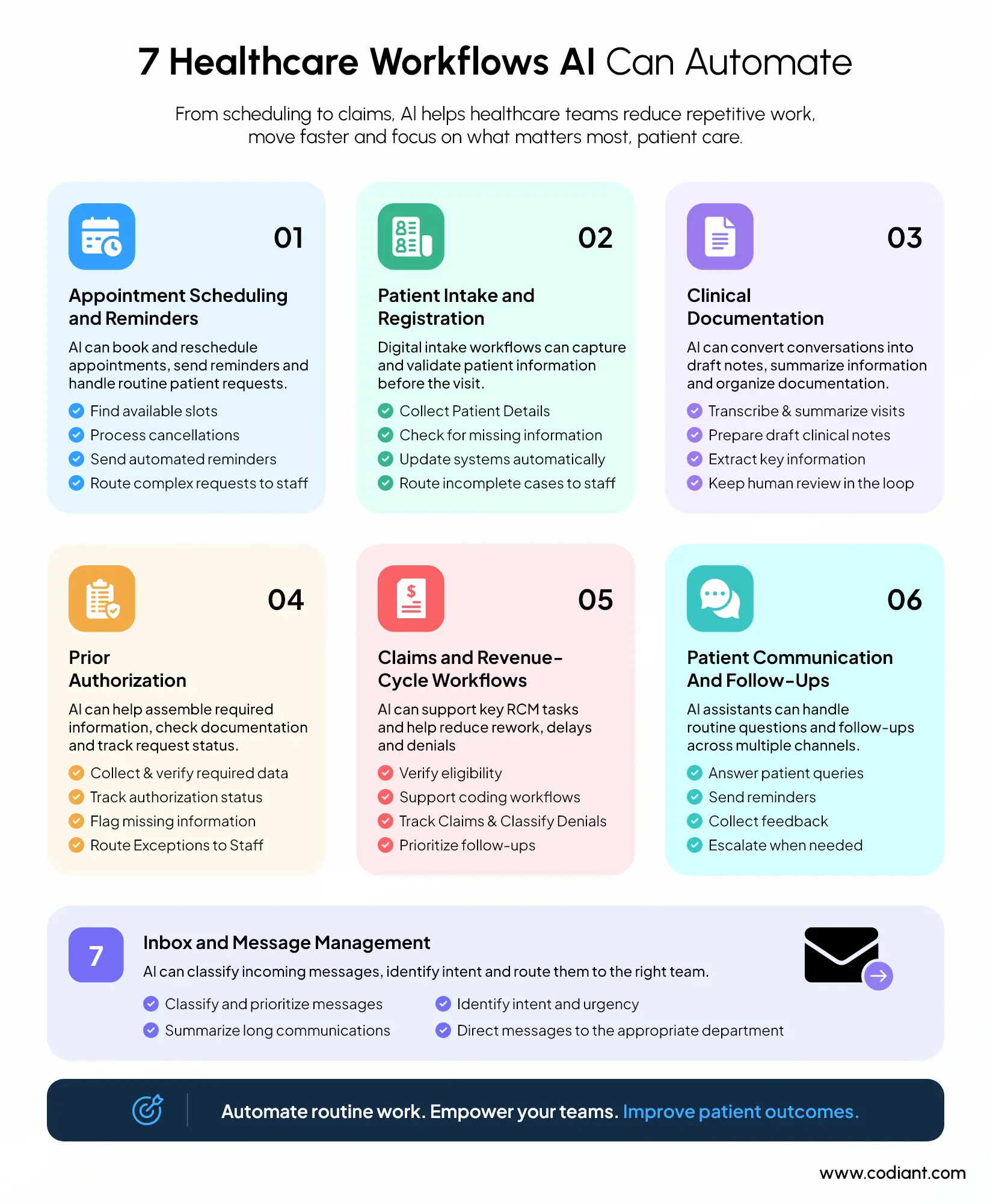
Healthcare organizations manage thousands of repetitive tasks every day. Many follow predictable steps, rely on information already stored in digital systems, and only require human intervention when something falls outside predefined rules.
That makes workflows such as patient scheduling, registration, clinical documentation, referrals, prior authorization, claims processing, patient communication, reporting, and routine administrative coordination strong candidates for healthcare automation.
The opportunity is not to automate every process. It is to identify where routine work can move automatically, where exceptions should be escalated, and where clinical or administrative judgment still needs to remain with people.
1. Appointment Scheduling and Reminders
AI-enabled scheduling can help patients find available appointments, process cancellations, send reminders, and route complex requests to staff. Voice AI agents for appointment scheduling can further support front-desk workflows by handling routine appointment conversations, while conversational AI for patient experience can extend automation across common patient interactions.
For hospitals, better coordination between scheduling, triage, and operational systems can also help address bottlenecks that contribute to longer waits. Our analysis of how AI reduces patient wait times explores this use case in more detail.
2. Patient Intake and Registration
Patient intake often begins before a patient reaches the front desk. Demographics, insurance information, consent forms, medical questionnaires, and other required details need to be collected, checked, and entered into the appropriate systems.
Automation can move much of this process forward before the visit. Digital workflows can capture patient information, check required fields for completeness, flag missing details, and update permitted systems when integrations allow.
When information is incomplete or requires verification, the workflow can route the case to staff for review. This turns patient intake automation into a structured process where routine steps move faster while exceptions continue to receive human attention.
3. Clinical Documentation
AI can convert clinician-patient conversations into draft notes, summarize information, and organize documentation. This is one practical application of generative AI in healthcare documentation, although clinicians should still review generated content before it becomes part of the medical record.
The potential is already measurable. The AMA reported that 7,260 Permanente physicians used ambient AI documentation across more than 2.57 million patient encounters during a 63-week evaluation, with significant reductions in note-taking time and after-hours documentation.
Clinical documentation is a strong example of human-in-the-loop automation: AI prepares the draft, while the clinician verifies and approves the clinical record.
4. Prior Authorization
Prior authorization often involves gathering information from multiple sources, checking documentation requirements, submitting requests, and following up on their status. Missing or incomplete information can add another round of administrative work.
AI and workflow automation can help move these steps forward by assembling required information, checking documentation for completeness, tracking authorization status, and flagging missing details. When a request is denied or falls outside predefined rules, it can be routed to the appropriate team for review.
The goal is not to automate clinical or coverage decisions. It is to reduce the repetitive work surrounding them while keeping human review in place based on the workflow, regulatory requirements, and potential consequences of an error.
5. Claims and Revenue-Cycle Workflows
Healthcare workflow solutions can assist with:
- Eligibility verification
- Claim preparation
- Coding-support workflows
- Claim-status checks
- Denial classification
- Payment posting
- Missing-document detection
- Follow-up prioritization
6. Patient Communication and Follow-Ups
AI assistants can support routine appointment questions, reminders, billing queries, post-visit instructions, feedback collection, and follow-up workflows.
The system should include escalation rules so clinical questions, emergencies, complaints, and uncertain requests reach an appropriate human rather than receiving an unsafe automated response.
7. Inbox and Message Management
AI can classify incoming messages, identify intent, summarize long communications, prioritize urgency based on approved rules, and direct messages to appropriate teams.
Which Healthcare Workflows Should You Automate First?
Identify repetitive, high-volume processes where AI can reduce manual effort and deliver measurable operational value.
What Are the Benefits of Healthcare Workflow Automation?
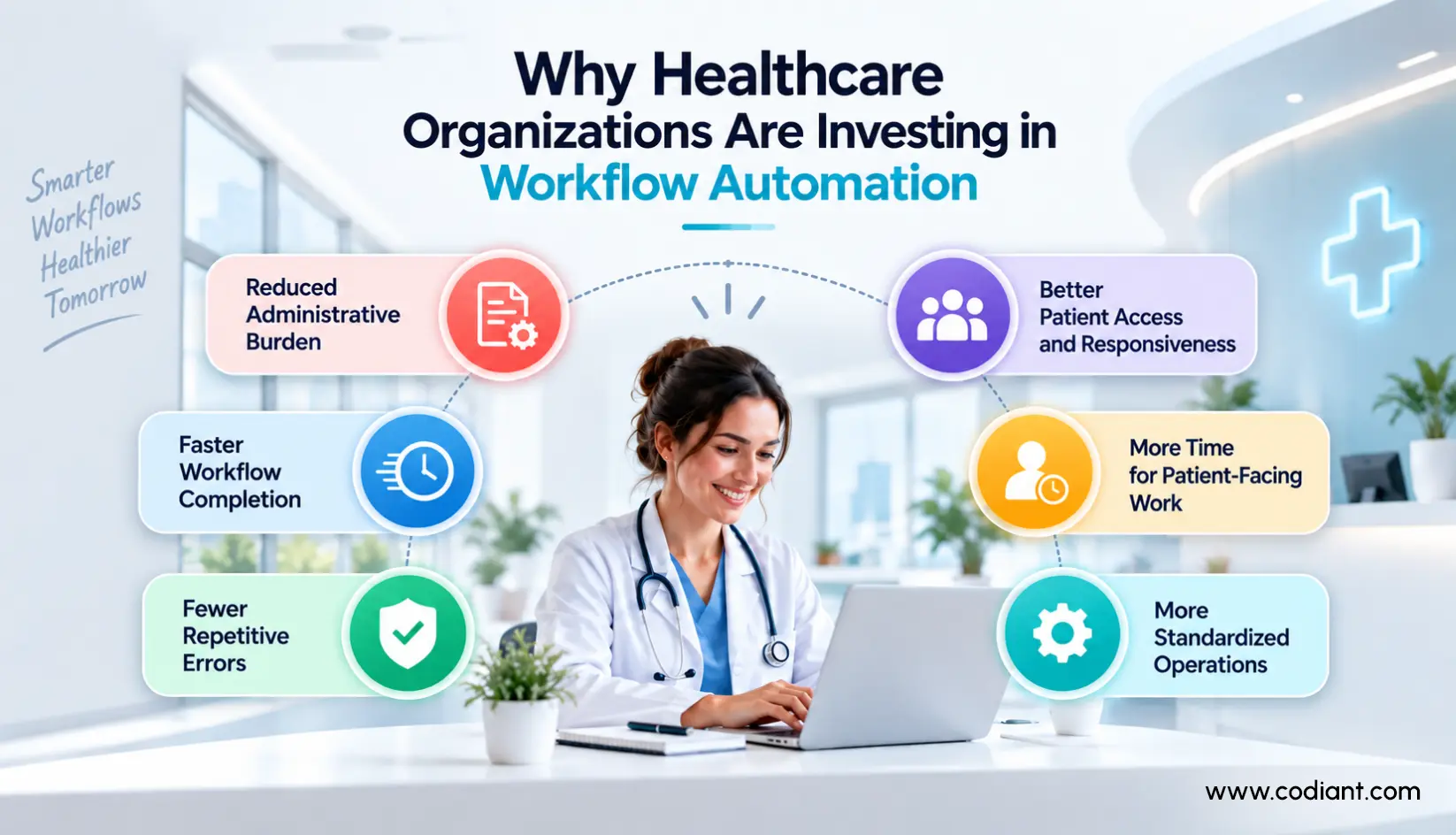
The main benefits of healthcare workflow automation are lower administrative effort, faster processing, greater workflow consistency, better use of staff capacity, and potentially improved patient and clinician experiences. The actual impact depends on which process is automated, its baseline performance, adoption, integrations, and exception rate.
1. Reduced Administrative Burden
Automation can remove repetitive data entry, status checking, document routing, and routine communication from staff queues.
This does not necessarily mean reducing headcount. Healthcare organizations can use recovered capacity for patient communication, exception handling, complex cases, and other tasks that require human judgment.
2. Faster Workflow Completion
Connected automation reduces handoffs between systems and people. Information can move directly from one approved workflow stage to another rather than waiting for manual transfer.
3. Fewer Repetitive Errors
Rules, validation, and standardized data flows can reduce errors caused by duplicate entry, missing fields, or inconsistent process execution.
AI outputs, however, introduce their own potential errors. Automation therefore requires validation controls rather than an assumption that machine-generated output is inherently accurate.
4. Better Patient Access and Responsiveness
Automating routine scheduling, reminders, status updates, and frequently requested information can reduce waiting for administrative assistance and make self-service available outside normal office hours.
5. More Time for Patient-Facing Work
This is one of the clearest potential benefits for clinicians. The Permanente Medical Group’s ambient AI experience found that 84% of surveyed physicians reported a positive effect on patient communication, while 82% reported improved work satisfaction.
6. More Standardized Operations
Automation can encode defined workflow stages, permissions, routing logic, and escalation paths. For multi-location healthcare organizations, this can help reduce unnecessary process variation while still allowing site-specific exceptions.
How Does AI Improve Healthcare Workflows?
AI allows workflow automation to move beyond fixed rules by interpreting messages, documents, conversations, and other unstructured information. More advanced AI agents for business workflow automation can also coordinate actions across multiple tools and workflow stages while escalating exceptions that require human judgment.
Consider an incoming patient message. A basic workflow might only route the message based on a manually selected category.
An AI-assisted workflow can potentially identify the request type, summarize the message, retrieve relevant permitted information, determine the appropriate queue, draft a response for approved use cases, and escalate uncertain or clinically sensitive cases.
This makes AI particularly useful when healthcare processes combine structured workflows with unstructured information.
However, the appropriate automation boundary is critical. AI should not silently turn a workflow-efficiency tool into an unsupervised clinical decision-maker. High-impact outputs need appropriate validation, accountability, and human oversight.
How Should AI Integrate With EHR, EMR and Existing Healthcare Systems?
Healthcare organizations rarely start with a blank technology stack. Patient data, clinical records, billing information, scheduling, and operational workflows already live across EHRs, EMRs, legacy applications, and third-party platforms. AI needs to work within that environment rather than create another disconnected system.
The integration layer is therefore critical. APIs and healthcare interoperability standards such as HL7 FHIR can allow authorized clinical and administrative data to move between healthcare applications in a structured format. FHIR is specifically designed to support the electronic exchange of clinical and administrative health information.
For organizations working with older infrastructure, integration may also require AI legacy system modernization. Instead of replacing every existing application, healthcare organizations can progressively expose legacy functions through APIs, improve data quality, and introduce AI capabilities around systems that still serve an important operational purpose.
Generative AI introduces another consideration: how the model gets the context it needs without treating the EHR itself as an AI model. Retrieval-augmented generation (RAG) can connect an AI application to approved external knowledge sources and retrieve relevant information when a request is made, allowing generated responses to be grounded in retrieved context rather than relying solely on the model’s training data.
The architecture should ultimately control what information AI can access, what it can write back, what actions it can trigger, and when human approval is required. In healthcare, successful AI integration is not simply about connecting a model to an EHR. It is about building a secure, interoperable layer that allows AI to support existing workflows without compromising the controls around sensitive healthcare data.
Need AI to Work with Your Existing Healthcare Systems?
Build secure AI workflows that connect with EHR/EMR platforms, legacy applications, patient systems, and existing data infrastructure.
What Are the Biggest Challenges of Workflow Automation in Healthcare?
The biggest challenges are fragmented systems, poor data quality, integration complexity, privacy and security requirements, AI accuracy, workflow resistance, unclear ownership, and difficulty proving ROI. Automating a poorly designed process can simply make the same problem happen faster.
1. Legacy Systems and Interoperability
Hospitals frequently operate multiple systems built at different times and for different purposes. Automation becomes difficult when information cannot move reliably between them.
2. Data Quality
AI cannot compensate for every incomplete, inconsistent, duplicated, or incorrectly mapped record. Data readiness should therefore be assessed before automation.
3. AI Accuracy and Hallucinations
Generative AI solutions can produce incorrect information. The risk level is especially important when generated information enters a clinical record or affects patient-facing communication.
That makes confidence thresholds, validation, human review, and auditability core design requirements rather than optional additions.
4. Security and Privacy
Workflow automation may move ePHI between applications, APIs, cloud services, AI systems, and vendors. Every additional data path needs to be understood and appropriately protected.
The current HIPAA Security Rule requires regulated entities to use administrative, physical, and technical safeguards to protect the confidentiality, integrity, and availability of ePHI.
5. User Adoption
A technically successful system can still fail if it adds clicks, creates extra review work, produces low-quality output, or does not fit how clinicians and staff actually operate.
Healthcare automation should therefore begin with workflow observation and stakeholder involvement rather than technology selection alone.
Is AI Healthcare Workflow Automation HIPAA Compliant?
AI healthcare workflow automation can be implemented in a manner that supports HIPAA compliance, but AI or automation is not inherently “HIPAA compliant.” Compliance depends on the regulated entity’s circumstances, data flows, safeguards, vendor relationships, policies, risk management, and how the technology creates, receives, maintains, or transmits ePHI.
Organizations evaluating an AI-enabled workflow should therefore examine:
- What PHI/ePHI enters the workflow
- Where that information is processed and stored
- Which vendors and subcontractors can access it
- Whether required business associate agreements are in place
- Authentication and role-based access
- Encryption and secure transmission
- Audit logging
- Data retention and deletion
- Incident-response procedures
- AI model data-use and training policies
- Human oversight
- Ongoing risk assessment and monitoring
Also, HIPAA compliance is an organizational and technical responsibility, not a product badge.
What Is the ROI of Healthcare Automation?
Healthcare automation only creates value when the time, cost, and effort it saves outweigh what it takes to build, integrate, and operate it.
That is why ROI should start with the workflow you have today. How much staff time does it consume? Where does rework happen? How often do delays or errors occur? What does the process currently cost? Once that baseline is clear, organizations can compare it against measurable improvements after automation.
A simple way to calculate it is:
ROI (%) = [(Annual Quantified Benefits − Annualized Automation Cost) ÷ Annualized Automation Cost] × 100
Consider a healthcare organization spending $300,000 annually to implement and operate an automated workflow. If validated labor-capacity savings, reduced rework, and other measurable benefits total $450,000 a year, the calculation would be:
($450,000 − $300,000) ÷ $300,000 × 100 = 50% ROI
In this example, the automation generates a 50% return relative to its annualized cost. This is an illustrative calculation, not an industry benchmark.
But ROI in healthcare is not limited to dollars saved. Leaders should also track operational changes such as processing time, staff hours released, error and rework rates, authorization turnaround time, claim denials, patient wait times, workflow completion rates, and exception volumes.
The strongest business case connects these operational improvements back to measurable financial value. Instead of asking “How much can healthcare automation save?”, organizations should ask “What is this workflow costing us today, and what measurable value will automation change?”
| ROI Dimension | Metrics to Track |
| Labor efficiency | Staff hours saved, touches per case |
| Process efficiency | Cycle time, turnaround time, queue size |
| Quality | Error rate, rework, exception rate |
| Financial | Cost per transaction, administrative cost, denied/reworked claims |
| Clinical workforce | Documentation time, after-hours EHR time |
| Patient experience | Response time, scheduling completion, abandonment |
| Technology | Automation success rate, uptime, integration failures |
| Adoption | Usage rate, override rate, staff satisfaction |
Build the Business Case Before You Automate
Map your current workflow, identify automation opportunities, and define the KPIs needed to measure real business impact.
How Should Healthcare Organizations Implement Workflow Automation?
Organizations planning agent-based automation should first define what the agent can access, which actions it can perform, where human approval is required, and how its outputs will be monitored. Understanding how to build AI agents for workflow automation can help teams move from a workflow concept to a controlled implementation.
A practical implementation roadmap is:
- Map the existing workflow. Identify users, systems, inputs, handoffs, delays, exceptions, and decision points.
- Establish baseline metrics. Measure current time, cost, error rate, throughput, and service levels.
- Prioritize automation opportunities. Focus on high-volume, repetitive workflows where automation can create measurable value.
- Define the automation boundary. Specify what AI can perform, what requires validation, and what must remain under human control.
- Design integrations and data flows. Connect EHR/EMR, scheduling, billing, payer, communication, and other required systems.
- Build security and governance controls. Address access, ePHI, logging, risk management, vendors, and escalation.
- Pilot with a controlled user group. Validate accuracy, usability, workflow fit, and exception handling.
- Measure against the baseline. Determine whether the pilot actually reduced cost, time, errors, or workload.
- Scale only after evidence. Extend successful patterns across departments or locations while continuously monitoring performance.
This approach prevents an organization from measuring AI adoption when what it actually needs to measure is workflow improvement.
Where Should Healthcare Leaders Start?
Healthcare leaders should start with workflows where administrative burden is high and the business outcome is measurable, rather than choosing AI technology first. Scheduling, documentation, eligibility verification, prior authorization support, claims workflows, patient communication, and repetitive data processing can all be reasonable candidates depending on the organization.
The initial business case should answer five questions:
- What does the workflow cost today?
- Where does time get lost?
- What can safely be automated?
- What systems must connect?
- Which KPI proves success?
For CIOs and CTOs, interoperability, security, architecture, and governance become central. For COOs and administrators, throughput and staff productivity matter more. CFOs need attributable cost savings and payback. Clinical leaders need assurance that efficiency does not compromise care quality or increase documentation risk.
The same automation project therefore needs both a technical architecture and a measurable operational business case.
Building Healthcare Workflow Solutions with Codiant
Healthcare workflow automation works best when the technology is designed around the actual clinical and administrative process rather than forcing teams into another disconnected system.
Codiant’s healthcare software development services cover healthcare platforms, AI-powered solutions, healthcare AI agents, care-management systems, patient-engagement solutions, software modernization, and integration with EHR/EMR, laboratory, insurance, pharmacy, and other systems. Codiant also describes AI applications for workflow automation, clinical data processing, predictive insights, and administrative support.
For organizations handling ePHI, workflow design should incorporate security and compliance requirements from discovery onward. Codiant’s HIPAA development framework similarly recommends mapping ePHI data flows, performing formal risk analysis, implementing safeguards, testing the environment, and establishing ongoing compliance operations rather than treating compliance as a final-stage checklist.
Conclusion: From Manual Workflows to Intelligent Healthcare Operations
Healthcare workflow automation is not about putting AI into every process. It is about identifying where time is being lost, where repetitive work is slowing teams down, and where connected automation can make healthcare operations work better.
The most effective implementations start with the workflow, not the technology. Organizations need to understand the existing process, establish measurable baselines, define what can safely be automated, connect the right systems, and keep human oversight wherever judgment or higher-risk decisions are involved. This aligns with the implementation approach developed throughout the blog.
For healthcare leaders, that creates a more practical path forward: start with a high-value workflow, prove the operational and financial impact, and scale automation where the evidence supports it. The result is not simply more AI, but healthcare operations designed to reduce administrative friction while giving teams more capacity for work that requires human attention.
Ready to Automate Your Healthcare Workflows?
Identify high-cost manual workflows and build an AI automation roadmap around measurable ROI.
The Author

Frequently Asked Questions
AI can automate or assist administrative workflows by extracting information, classifying requests, generating drafts, routing tasks, triggering follow-ups, and connecting actions across healthcare systems. Common applications include scheduling, intake, documentation, eligibility checks, prior authorization support, claims processing, patient communication, and reporting.
The main challenges are legacy-system integration, fragmented data, inconsistent processes, AI accuracy, security and privacy, regulatory requirements, staff adoption, and exception handling. Organizations should map the existing workflow and its risks before automating it rather than transferring an inefficient manual process directly into software.
AI workflow automation can support a HIPAA-compliant environment, but it is not automatically HIPAA compliant. For regulated entities, compliance depends on how ePHI is collected, processed, stored, transmitted, and protected, together with applicable safeguards, risk analysis, access controls, policies, and business-associate arrangements.
There is no credible universal price for healthcare workflow automation. Cost varies with workflow complexity, AI capabilities, EHR/EMR integrations, data migration, security requirements, number of users and locations, cloud infrastructure, testing, and ongoing support. Without a defined workflow and integration scope, we cannot confirm an accurate project cost.
Healthcare organizations can measure automation ROI by comparing pre- and post-implementation metrics such as staff hours, cost per transaction, turnaround time, error and rework rates, throughput, after-hours documentation, and patient response times. Financial ROI can then be calculated as (quantified benefits − automation cost) ÷ automation cost × 100.
Featured Blogs
Read our thoughts and insights on the latest tech and business trends

Node.js Backend Development: A Complete Guide for 2026
- October 5, 2026
- Software Development
Node.js backend development involves building server-side applications using JavaScript to manage business logic, APIs, databases, authentication, and communication between systems. It helps businesses develop web and mobile applications that handle multiple simultaneous requests without creating... Read more

How Much Does It Cost to Hire a Dedicated Flutter Developer in 2026?
- September 24, 2026
- Staff Augmentation
Hiring a dedicated Flutter developer in 2026 typically costs $15–$30 per hour for junior talent, $30–$60 for mid-level developers and $60–$100+ for senior specialists. For a 160-hour working month, that equals approximately $2,400–$4,800, $4,800–$9,600 and... Read more

Mobile Banking Application Development: A Complete Guide
- September 17, 2026
- Banking & Financial
Mobile banking app development requires five coordinated workstreams: product design, mobile and backend engineering, core banking integration, security and compliance, and post-launch operations. The process affects banks, credit unions, fintech startups, and financial institutions that... Read more